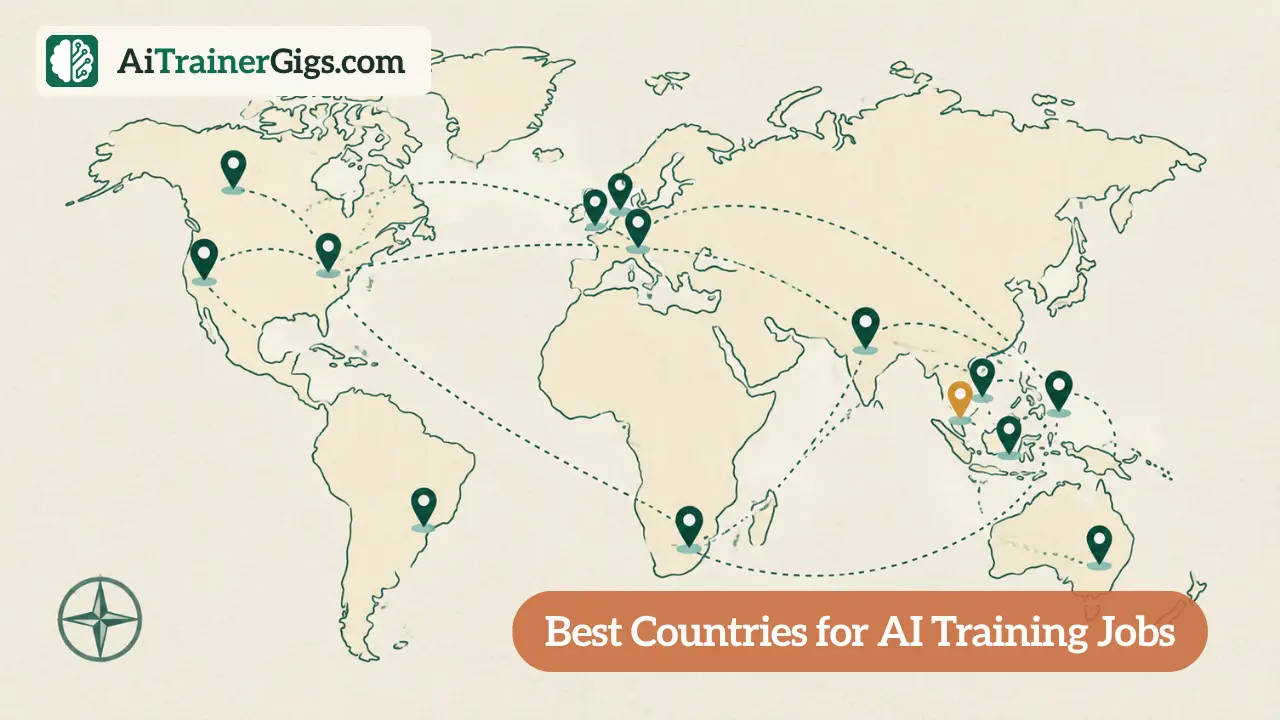
The best countries for AI training jobs depend on what you want most. The US, Canada, the UK, Ireland, Australia and New Zealand get the highest pay and the most platforms. India, Pakistan, the Philippines, Indonesia and Brazil get the best value, because USD pay goes much further there. And here's the part most people miss: a large share of AI training gigs are open to dozens of countries at once.
I run AiTrainerGigs, a job board for this exact kind of work, and the question I get more then any other is some version of "can I do this from my country?" The honest answer is usually yes, but which platforms you can join, how much you'll earn and how you'll get paid all shift depending on where you live.
In this post I'll rank the best countries by pay, by value and by language demand. I'll show you which platforms accept which countries, where it's harder to get in, how location changes your pay, and how to actually get your money out. You'll finish knowing exactly which doors are open to you.
Best countries for AI training jobs: the short answer
There is no single best country. There are three different "bests", and you should pick the one that matches your goal:
Best for pay: United States, Canada, United Kingdom, Ireland, Australia, New Zealand. They can join the most restricted, highest-paying platforms.
Best for value: India, Pakistan, Bangladesh, the Philippines, Indonesia, Brazil and much of Latin America. Lower pay per hour on some platforms, but USD income has huge local buying power.
Best for language work: Germany, Spain, France, Japan, plus Arabic-speaking and Spanish-speaking countries. Native speakers of these languages are in steady demand for bilingual projects.

Where are AI training jobs available?
AI training jobs are available in most countries around the world, but not every platform is open everywhere. Each platform sets its own list, and some individual projects narrow that list even further.
That's why lists of the best countries for AI training jobs can feel contradictory. One site says a platform is "global", another says it's limited to a handful of countries, and both can be right for different projects on the same platform. The country shown when you sign up, and on each project's page, is the only list that really counts.
Remote doesn't mean open everywhere
This catches people out all the time. A listing says "remote", you apply, and weeks later you find out it was only open to five countries. "Remote" just means you don't go to an office. It says nothing about which countries can apply.
Every serious listing has a country or location line somewhere. That line matters more than the word remote. On AiTrainerGigs you can browse ai training jobs by country to see what's open where you live, instead of guessing.
Why platforms limit countries
This is also why the best countries for AI training jobs look the way they do. Platforms don't restrict countries to be unfair. The reasons are mostly boring and legal:
Payments. A platform that pays only through PayPal can't easily pay someone in a country where PayPal doesn't work.
Tax and contracts. Every new country means new tax forms and contractor rules. Some companies only bother with a handful.
Client requirements. The AI lab paying for the project may demand workers from specific countries, often for data-privacy or security reasons.
Language and culture. A project rating US legal answers needs people who understand US law and culture. A Japanese chatbot project needs people in Japan.
Sanctions. Companies with US ties legally can't pay workers in sanctioned countries.
Fraud history. Sometimes a platform closes a country after a wave of fake accounts or account selling. Honest workers get caught in that net, which isn't fair, but it happens.
Knowing these reasons helps. They tell you which platforms are likely to accept you and which are a waste of an application.
Which platforms accept which countries
The easiest way to think about this is in three tiers. The more restricted the platform, the higher the pay tends to be.
Tier 1: restricted, higher pay
These platforms accept only a short list of countries, usually rich English-speaking ones.
DataAnnotation is reported to open its general pool mainly to the US, Canada, the UK, Ireland, Australia and New Zealand. Bilingual projects do open up in other countries from time to time, so it's not a hard wall for language workers. Pay is reported around $20–$40 an hour.
Handshake AI is US-only for its fellowship work.
Live in one of those countries? Apply here first. Everyone else should skip to tier 2.
Tier 2: broadly open, priced by skill
These platforms accept workers from many countries and set pay mostly by the skill a project needs, not by where you live.
Outlier reportedly works in more than 100 countries and territories, though it doesn't publish a full list and some projects are limited further.
Alignerr, Mercor, Micro1 and Terac recruit globally for many roles, especially coding, STEM and professional expert work.
For most people outside the six "tier 1" countries, this is where the best money is. A skilled worker in India or Brazil can earn rates close to US levels here.
Tier 3: nearly universal, priced by region
These are the giants that accept contributors from well over 100 countries. The trade-off is that pay is often adjusted to your local market.
Appen / CrowdGen reports coverage in 170+ countries.
TELUS Digital, Toloka and OneForma are open across most of the world, with many language-specific projects.
Welo Data and Sigma AI run large multilingual rater and language programmes.
These are the easiest platforms to get onto almost anywhere. They're a solid starting point while you apply to tier 2.

Platform | Typical country access | How pay is set | Typical pay (USD/hr) |
|---|---|---|---|
DataAnnotation | Mainly US, CA, UK, IE, AU, NZ | By project/skill | $20 – $40+ |
Handshake AI | US only | By expertise | Higher tier |
Outlier | 100+ countries | Mostly by skill | $15 – $50 |
Alignerr | Global (role-dependent) | By skill | $15 – $60 |
Mercor / Micro1 | Global (role-dependent) | By expertise | $20 – $150+ |
Terac | 115+ countries (reported) | By role | $24 – $40 |
Appen / CrowdGen | 170+ countries | Often by region | $5 – $20 |
TELUS Digital / Toloka | 100+ countries | By region | $3 – $15 |
OneForma / Welo Data | Multilingual, global | By language/project | $8 – $20 |
Pay figures are reported ranges and change often, so always check the rate shown on a project before you start.
Best countries ranked by what matters to you
Now let's rank the best countries for AI training jobs properly, by the three things people actually care about.
Highest pay: US, Canada, UK, Ireland, Australia, New Zealand
These six countries can join every tier, including the restricted, higher-paying ones. They also get the most US-focused projects, like rating answers about US law, healthcare or culture.
United States: the deepest pool of work and the highest rates. Many expert projects are US-only.
Canada, UK, Ireland: close behind, with access to most US-style projects.
Australia and New Zealand: good access and solid rates, though time zones can make live projects awkward.
There's another catch people don't talk about much: competition. Because these countries can apply everywhere, so can millions of other people there, and the most popular projects fill up fast. A tier 1 passport gets you in the door. It doesn't guarantee a full queue.
The other catch is cost of living. $20 an hour goes a lot less far in London or San Francisco than in Lahore.
Best value for USD pay: India, Pakistan, Bangladesh, Philippines, Indonesia, Brazil
This is where AI training can be genuinely life-changing. Tier 2 and tier 3 platforms are widely open here, and payment is usually in US dollars.
India: a huge English-speaking talent pool and strong demand for coding, STEM and Hindi-language work.
Pakistan and Bangladesh: lots of annotation and expert-pool opportunities. The main headache is payment (more on that below).
Philippines: excellent English, a long history of remote and BPO work, and a strong fit for rating and writing tasks. I've written a separate guide on remote AI training work in the Philippines if that's you.
Indonesia and Malaysia: growing demand, especially for Bahasa and multilingual projects.
Brazil and Latin America: Portuguese and Spanish projects, plus time zones that overlap well with US teams.
Even a modest $10–$15 an hour can beat local professional salaries in several of these countries. That's why competition for good projects is fierce.
Best for language and bilingual work
Languages are an underrated way in. AI models need training in every major language, and native speakers are hard to find for some of them.
German, French, Spanish, Italian, Portuguese: steady demand across Europe and Latin America.
Japanese and Korean: fewer projects but often well paid, because qualified raters are scarce.
Arabic: strong demand across the Middle East and North Africa.
Less common languages (Tagalog, Swahili, Bengali, Urdu, Vietnamese and others): small but real pockets of work with less competition.
Bilingual projects can appear even on platforms that are normally restricted, so a second language widens your options wherever you live.
Best for experts
For specialists, geography matters least of all. Lawyers, doctors, nurses, engineers, coders and PhD-level scientists are recruited globally on tier 2 platforms, often at $40–$150 an hour.
That said, some professional projects need local knowledge. A US legal project wants US-licensed lawyers. A UK medical project wants UK clinicians. Check whether your credentials match the project's country.
Expert work also tends to come with a tougher entry process: a CV review, a skills test in your field and sometimes a short video interview, which on some platforms is run by an AI interviewer. It takes longer to get in, but once you're through, the projects are usually better paid and less crowded than general rating work. A doctor in Egypt or an engineer in Poland can land the same project as someone in Chicago, as long as the subject doesn't depend on local rules.
Countries where it's harder to get in
Some places face more barriers than others. It's better to know this up front than to waste hours on applications.
Sanctioned countries. Russia, Iran, North Korea and Belarus are excluded by nearly every major platform, along with other US-sanctioned regions such as Cuba and Syria. This is a legal rule, not a platform choice, and there's no way around it.
Platform-level exclusions. Some platforms leave out certain countries for business reasons. Outlier, for example, has been reported to exclude Nigeria, Ghana and Kenya, while including Egypt, South Africa and others. Other companies have advertised "worldwide" roles and then told applicants from specific African countries that they can't hire them.
Payment gaps. A country might be technically allowed but still hard to work from because the platform's payment method doesn't operate there.
None of this says anything about the people in those countries. Usually it comes down to payment rails, past fraud waves on a platform, or compliance costs. Tier 3 platforms and some tier 2 platforms still recruit in most of Africa, so the door isn't fully closed.
Does your country change your pay?
Yes, often. How much depends on the platform's pay model.
Region-priced platforms adjust rates to your local market. For rater work at TELUS Digital, for instance, reported rates are roughly $12–$15 an hour in the US, £9–£11 in the UK, €10–€12 in Germany, and about $3–$6 an hour in lower-cost countries, for very similar tasks.
Skill-priced platforms pay mostly by the project and your expertise. Outlier and Alignerr lean this way, which is why they're attractive outside the richest countries. Even so, the same task can sometimes pay less depending on the country you're verified in.
Expert platforms like Mercor pay by profession and seniority, and location matters least here.
Here's a simple way to picture it. Imagine two people doing the same search-rating task for 20 hours a week. On a region-priced platform, one in the US might earn around $1,100 a month and one in a lower-cost country around $350. Switch both of them to a skill-priced writing project at $20 an hour and they'd each earn about $1,600. Same people, same hours, very different outcome, just because of the pay model.
So what should you take from this? From a lower-cost country, aim your energy at skill-priced and expert work rather than region-priced crowd tasks. That's where the gap closes.
Getting paid from your country
Acceptance is only half of it. You also need a way to receive the money.
PayPal, Payoneer, Airtm and bank transfer
Platforms use different payment rails, and some offer a choice:
PayPal is the most common, especially on DataAnnotation and Outlier.
Payoneer is popular with larger platforms and works in many countries where PayPal doesn't.
Airtm and similar wallets are used for some platforms and are popular in Latin America and Africa.
Direct bank transfer or Wise is offered by some expert platforms.
Fees and exchange rates eat into your pay, so compare the options before you choose one. A couple of percent on every payout adds up over a year.
When PayPal isn't available
PayPal can't receive payments in some countries, including Pakistan and Bangladesh. This is one of the most common frustrations on Reddit. One worker posted that they'd finally been accepted onto DataAnnotation, only to realise PayPal wasn't available where they lived.
Your options:
Pick platforms that pay through Payoneer, Airtm or bank transfer.
Check a platform's payment page before you spend hours on its assessment.
Never use someone else's PayPal account. It breaks most platforms' terms and can get you banned and unpaid.
Tax basics as an independent contractor
You'll almost always work as an independent contractor, which means no tax is taken out for you.
In the US, you'll usually get a 1099 and should set aside around 25–30% for federal and self-employment tax.
Outside the US, you'll typically sign a W-8BEN form for a US-based platform, and you pay tax under your own country's freelance rules.
Keep simple records from day one: date, platform, amount received in USD and the amount that landed in your local account after fees. Some countries also have thresholds where freelance income must be registered or where you start paying into social security. Rules differ alot by country, so a quick chat with a local accountant is worth it once your earnings become regular.
What workers on Reddit say about location
I read through recent threads on r/WFHJobs, r/DataAnnotationTech and country subreddits. The same themes kept appearing.
"Accepted, but I can't get paid." Several people celebrated being accepted, then hit the PayPal wall. Replies pointed them to Payoneer or Airtm options on some platforms.
"It said worldwide, then they said no." A long thread on r/Kenya described a worker being told by an AI training company that they don't hire from Kenya, even though the role was listed as worldwide. Others in the thread said they'd seen the same thing on more than a dozen sites.
"Stuck on 'no suitable jobs' for years." On r/DataAnnotationTech, someone outside the main countries said they'd registered over two years ago and never even recieved a screening test. Their dashboard simply said there was no suitable work.
"No work anyway." A blunter reply under one post: even if you get in, you might not have work available. Eligible isn't the same as busy.
On the positive side, workers in India, the Philippines and Latin America regularly post about steady income from tier 2 and tier 3 platforms, often while noting that it took several applications before one stuck.
The lesson from all of these is the same: check country and payment eligibility first, then apply widely.
How to find AI training work from any country
Whichever of the best countries for AI training jobs you live in, or even if yours didn't make any list, the approach is the same. Here's what I'd do.
Read the country list, not just the word "remote"
Before you apply, find the location line in the listing or the platform's FAQ. No location line at all? Treat that as a warning sign and check before investing hours in a test.
Turn your language into an advantage
Speak a language other than English? Lead with it. Bilingual and native-language projects have less competition and open doors on platforms that are normally restricted. List every language you can read and write properly.
Be honest about your level, though. Language projects usually test you in that language, and a failed test can lock you out of it for a long time. Native or near-native fluency is what most of them want. Regional dialects can help too: projects sometimes ask specifically for Mexican Spanish versus Spain Spanish, or Egyptian versus Gulf Arabic, and that local knowledge is something a non-native can't fake.
Never use a VPN or someone else's ID
It's tempting when a top platform isn't open to you. Don't. Platforms check IDs, phone numbers, payment details and IP addresses. Get caught and you lose the account and usually any unpaid earnings. It's simply not worth it.
Avoid account sellers. People who "rent" or sell verified accounts from tier 1 countries are breaking platform rules, and buyers are the ones who end up banned without pay.
Stack 2–3 platforms that accept your country
Work comes in waves, and a single platform will leave you idle for weeks. Join two or three that accept your country, mixing a tier 3 platform for steady small tasks with a tier 2 platform for better-paid skilled work. My guide to the best ai training sites that pay compares the main options side by side.
Find AI training jobs in your country
My take: your skills matter more than your passport
Where you live does matter. It decides which platforms you can join, how some of them price your time and which payment methods you can use. The six rich English-speaking countries get the widest access, and that's just reality.
But I've seen the other side too often to think location is destiny. A careful writer in the Philippines, a coder in India or a bilingual teacher in Brazil can earn very well on the right platforms, and USD pay often goes three or four times further for them. The people who struggle are usually the ones who applied to a single restricted platform and waited.
So check what's open in your country, lean on your language and your skills, sort out payments before testing, and join a few platforms at once. Do that, and the best country for AI training jobs might turn out to be the one you're already in.