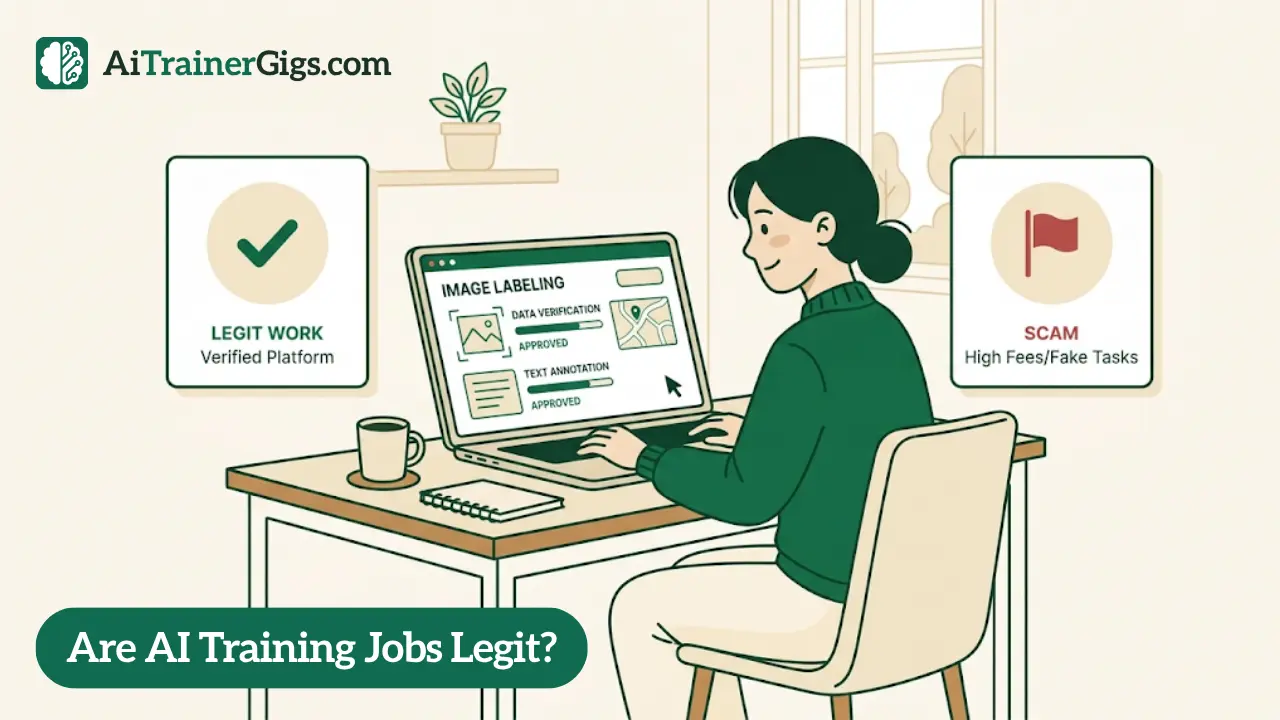
You have seen the ads. Remote work, flexible hours, and money for helping train AI. So are AI training jobs legit, or just another online trap? Here is the honest answer, plus the exact signs that split real work from a scam.
Short version: the work is real, and the demand is huge. AI companies need people to check, label, and improve what their models say. But scams hide in the same search results, so you need a quick way to tell them apart.
I will walk you through what the work actually is, the red flags that mean run, the green flags that mean go, and a simple checklist you can use on any platform. By the end you should be able to judge almost any offer in about two minutes.
Are AI training jobs legit? The short answer
Yes. AI training jobs are legit, and real companies pay real people to improve AI models every single day. The catch is that not every listing you find is one of them.
Think about why the work exists. Every chatbot, voice assistant, and image tool learns from human feedback. Someone has to label data, rate answers, and flag mistakes. That someone gets paid. So are AI training jobs real? They are, and the need for this human help keeps growing as more companies build their own models.
The problem is visibility. Because the work is remote and beginner-friendly, scammers copy the language and set traps. That difference is the whole game, and it is why so many people still ask, are AI training jobs legit?
What AI training work actually is
Let me clear up the mystery, because a vague idea of the job is exactly what scammers rely on. AI training is simply humans teaching a model to be more accurate and more helpful. You are the human quality check behind the tech.
Most tasks fall into a few buckets. You might do data annotation, which means labeling images, text, or audio so a model can recognise them later. You might rate and rank AI answers, telling the model which reply is better and why. This feedback loop is called RLHF, or reinforcement learning from human feedback, and it is just a fancy name for "people score the AI so it improves." Some roles ask you to write prompts or solve expert questions in your field, like law, medicine, or coding.
Here are the common task types in plain words:
Labeling photos, text, or sound (data annotation)
Comparing two AI replies and picking the better one (an AI rater or evaluator)
Checking answers for facts, safety, or tone
Writing example questions and model answers in your area of expertise
None of this needs a computer science degree. Good attention to detail and clear English go a long way, and many tasks welcome people with no experience.
Why so many scams cluster around these jobs
Scams follow money and hype, and AI has plenty of both. The words "remote" and "flexible" pull in millions of searches, so a fake AI training jobs scam post gets a lot of eyeballs fast.
There is a second reason too. The work sounds new and technical, so people are less sure what "normal" looks like. That uncertainty is what a scammer exploits. Not knowing the real process makes a fake one easy to sell.
So the jobs are legit, but your guard still needs to be up. Here is what to watch for.
AI training jobs scam red flags to walk away from
They ask you to pay upfront
A real employer pays you, not the other way around. Application fees, "starter kits," training costs, equipment deposits, background-check charges — all of it is definately a scam. Money should only ever flow toward you.
They contact you only on WhatsApp or Telegram
Real recruiters use company email, LinkedIn, or an application system. A six-figure "AI job" that lands in your WhatsApp out of nowhere is almost always fake. Random texts and chat-only hiring are a stop sign.
They promise huge, guaranteed money
No honest job promises $1,000 a day with zero effort. Real pay is solid but normal. Wildly high, guaranteed numbers are bait, not an offer.
The job is vague and won't say what you'll do
Legit platforms tell you the task clearly. A post that just says "train AI models" with no detail about the actual work is hiding something. If they can't explain the job, don't apply.
They want your bank details, ID, or SSN too early
Sensitive info like your Social Security number or bank login has no place in a first screening. Give it before you are hired and you are handing a stranger the keys. Legit onboarding asks for tax and payment details later, through a secure system.
The "free labor" test-task trap
This one is sneaky. Some fake posts ask you to spend hours labeling data as an "assessment," then send a rejection or go silent — and quietly keep your work. A short paid or clearly-scoped sample task is normal. Hours of unpaid "testing" is not.

How to tell a legit AI training job (the green flags)
Legit AI training jobs share a clear pattern, and once you see it you can spot it anywhere. The money moves one direction, from the company to you.
Watch for these good signs:
No fees to join, ever
The pay rate is shown before you accept a task
Your work gets human review, with clear reasons when you recieve a rejection
A real support channel exists if you get stuck
The company has a real website, address, and reviews on sites like Glassdoor or Reddit
Payment comes through PayPal, direct deposit, or wire — never gift cards or crypto
A genuine flow looks like this: you find a platform, apply, complete a qualification task, and if your work is good you start getting paid tasks. Simple and transparent.
A checklist to vet any platform yourself
Not sure about a specific site? Run it through this quick list before you spend any time on it, and you will know fast whether it is one of the legit AI training jobs or a trap.
Search the company name plus "review" and "Reddit." Real platforms have a trail.
Check for a proper website with a physical address and contact info.
Confirm there are no joining fees of any kind.
Read how and when they pay. Vague payment terms are a bad sign.
Look at the task description. Is it specific about what you will do?
See if pay is shown before you commit to work.
Trust your gut. Pressure, secrecy, and rush tactics all mean walk away.
Pass all seven and you are almost certainly looking at real work.
What a realistic first week and pay look like
Let me set honest expectations, because that is where scams get you. Real AI training work is steady, not a jackpot.
Your first week usually starts with a qualification or sample task. Get through it and paid tasks begin to appear, though the amount of work can go up and down. Some days are busy, some are quiet. That is normal, and it is not sign of a scam.
Pay depends on the platform, the task, and your skills. General tasks often sit around $10 to $40 an hour. Expert work — think coding, medicine, or law — can pay more, sometimes well above that. Entry-level tasks pay less but are the easiest way in. Anyone quoting far higher "guaranteed" numbers is selling a fantasy.
One more honest note: this is contract work, so you handle your own taxes. Keep a record of what you earn.
Legit AI training jobs vs "too good to be true"
Still torn on an offer? Line it up against this simple split.
A legit role: clear tasks, no fees, pay shown upfront, a real company, normal pay ranges, secure onboarding. A scam: pay to start, WhatsApp-only contact, giant guaranteed money, vague duties, early demands for your bank or ID, and hours of unpaid "tests."
If an offer leans toward the second column on even two or three points, close the tab. The real ones don't need to trick you.
How to find AI training work without the scams
Here is the part that saves you the most time. Still wondering, are AI training jobs legit on a given site? You don't have to vet every platform from scratch — that work can be done for you. AiTrainerGigs pulls real, paid gigs from vetted platforms like Mercor, Micro1, Outlier, DataAnnotation, Appen, and Toloka into one place, so you skip the sketchy corners of the internet.
Want to start safely? Browse the live job board to see real openings, check the platforms page to compare how each one pays and onboards, or read the Start Here guide if you are brand new. Every listing links straight to the platform's own application — no middleman, no fee.
That way you spend your energy on the work, not on dodging traps.
Conclusion
So, are AI training jobs legit? They are — as long as you know the signs. The work is real, the demand is real, and beginners get hired for it worldwide. The only thing standing between you and a paycheck is a scammer hoping you won't check.
Now you can check. Watch the money direction, refuse every upfront fee, and trust clear tasks over big promises. Do that, and you will find real remote AI work that actually pays. You have got this — go find your first gig.