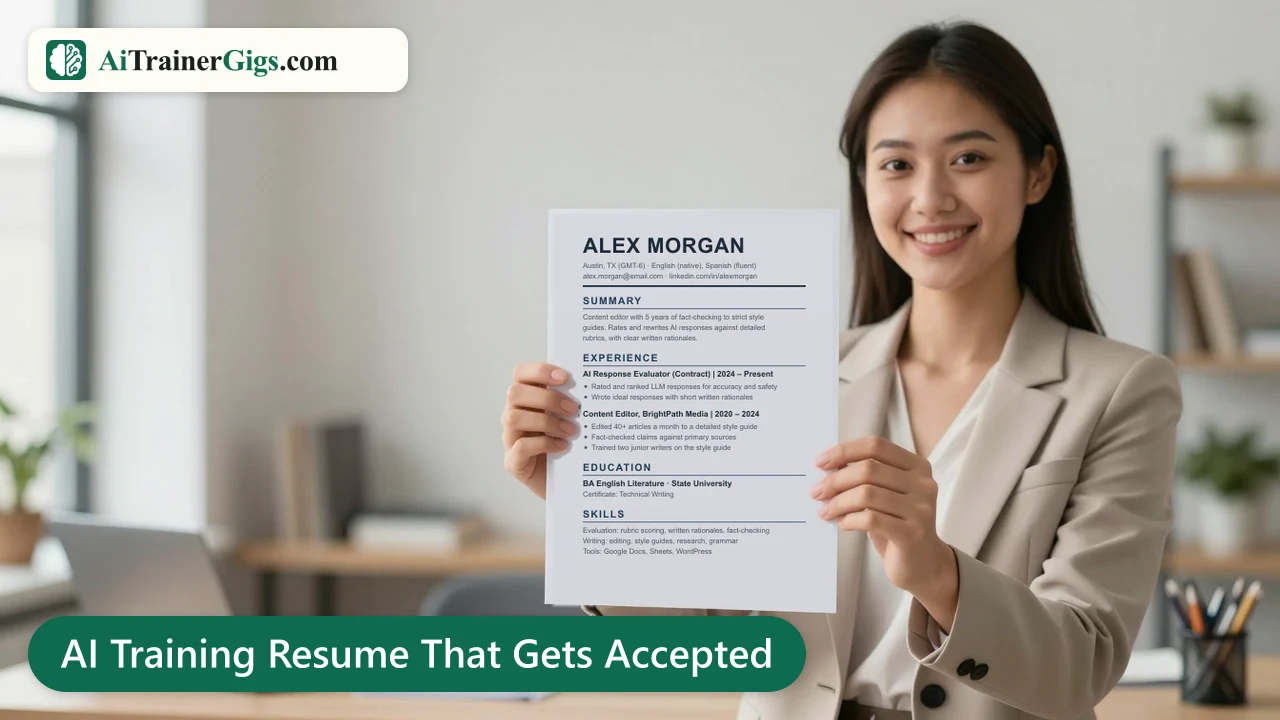
Your ai training jobs resume does two jobs at once. It gets you past the first automated filter on platforms like Mercor and Micro1, and then it becomes the script for the AI interview that follows. This guide shows you exactly how to build one that survives both.
I've watched a lot of people apply to AI training work with the same resume they'd send to a bank or a call centre. Most of them hear nothing back. The ones who get accepted usually changed three things: they led with their real domain expertise, they described their work in the language these platforms use (evaluation, rubrics, guidelines, judgment), and they only wrote lines they could defend out loud.
Below you'll get the structure, the wording, before-and-after bullet rewrites, two full resume examples you can copy, and a checklist to run before you hit Apply. New to this work? Read my guide on how to become an AI trainer first, then come back here to build the resume.
What Platforms Actually Look For in an AI Training Resume
An AI training resume is not a list of AI tools you've touched. Platforms that pay people to train and evaluate AI models (Mercor, Micro1, Outlier, Alignerr, Turing and others) want three things: real expertise in something, proof you can follow detailed rules, and clear writing.
Quick definition before going further. "AI training" here means human work that improves AI models: labeling data (data annotation), comparing and rating AI answers, writing ideal responses, and checking reasoning. The industry name for a big chunk of this is RLHF, which stands for reinforcement learning from human feedback. In plain words: humans grade the model's answers, and the model learns from those grades.
Domain expertise beats "AI experience"
This is the single biggest shift of the last two years. Early on, platforms hired huge numbers of generalists to label images and rate chatbot answers. Now the models are good enough that the valuable work needs experts: nurses checking medical answers, lawyers checking legal reasoning, developers grading code, PhDs writing hard science questions.
One commenter in a Mercor CV teardown on Reddit put it bluntly: generalist roles are shrinking, expert roles are booming. Another pointed out that the resume they were reviewing "leans heavily on AI training whereas Mercor looks for career experience."
So your career is the headline. Your AI training work (if you have any) is supporting evidence.
Proof you follow rules and make consistent judgments
Every AI training project comes with a long guideline document. Sometimes it's 30 pages, sometimes more. Your job is to apply those rules the same way, task after task, and flag the cases that don't fit.
That means employers look for signs of rule-following and judgment in your past work: QA checklists, compliance work, grading to a rubric, editing to a style guide, code review standards, clinical protocols. Any of those translate directly.
Clear writing (your resume is your first writing sample)
A huge share of this work is written: explaining why answer A beats answer B, rewriting a weak response, justifying a score. Reviewers know that. A resume with vague bullets, typos and jargon soup tells them how your task rationales will read.
Treat every bullet like a tiny writing test. Short, specific, active verbs, no filler.
How Mercor and Micro1 Screen Your Resume (and Why It Matters)
Both platforms use AI heavily in hiring, and both lean on your resume more than most traditional employers do. Here's the flow in plain terms.

Step 1: the resume or LinkedIn parse and the keyword match
You upload a resume (or connect LinkedIn) and the platform's system pulls out your titles, dates, employers, education and skills. It then compares that profile against the listing you applied to, and against other open projects.
The practical result: the words in your resume matter. A strong Mercor resume and a strong Micro1 resume look almost identical, because both systems reward the same thing, clear domain detail. A listing for "Biology Expert, PhD" is looking for biology, research, a PhD, and probably specific sub-fields. A resume that says "Scientist" with no detail won't match well, even if you're perfectly qualified.
Step 2: the AI interview is built from your resume
This is the part people miss. On Mercor, after you apply you usually take a short AI interview, and the questions are shaped by your resume and the role. Micro1 does something similar with its AI recruiter, Zara, who interviews you by voice or video.
So every line on your resume is a potential question. Wrote "built evaluation pipelines in Python"? Expect to be asked how. Listed "expert in organic chemistry"? Expect a technical question. An inflated line doesn't just fail to help, it actively sets you up to stumble on camera.
For the full picture of how each platform works, pay and all, read my breakdown of Mercor's hiring process and my Micro1 review. This guide sticks to the resume side.
What a rejection or silence usually means
Silence is the most common outcome, and it rarely means "you're bad." Usually it means one of three things:
- No current project matches your profile. Expert work comes in waves. You can sit in a talent pool for weeks before something fits.
- Your resume didn't match the listing's keywords. The system couldn't see the fit, even if it was there.
- The interview didn't line up with the resume. Vague answers about things the resume claimed confidently is a red flag.
Before reapplying, fix the resume, not just the cover note. Make the domain clearer, mirror the listing's language more closely, and then apply to listings that genuinely match what you've done.
The Ideal Structure of an AI Training Jobs Resume
Here's how to create a resume for AI training jobs that reads well to both machines and people. Keep the structure of your ai training jobs resume boring and predictable. Parsers love it, and so do human reviewers skimming hundreds of profiles. The same structure works whether a listing calls it a resume or a CV for AI training jobs.

Header: name, location and time zone, languages, links
Put these on two or three lines at the top:
- Full name
- City, country and time zone (projects often need overlap with a team or reviewer)
- Languages with level (e.g. "English (fluent), Spanish (native)"). Language skills open whole project categories.
- Email, LinkedIn, and GitHub or a portfolio if it's relevant
Skip your photo, date of birth and full street address. They add nothing and some parsers choke on them.
A 3-line summary that names one target lane
Your summary should tell the reader, in about three lines, what kind of AI training work you're aiming for and why you're credible. Pick one lane. A summary that says you can do coding, medicine, law and creative writing reads like nobody in particular.
Three templates you can adapt:
Generalist / writing lane
Writer and editor with 6 years of experience producing and fact-checking long-form content to strict style guides. Experienced in rating and rewriting AI-generated responses against detailed rubrics. Strong English grammar, research and clear written justifications.
STEM / coding lane
Software engineer with 5 years in Python and TypeScript, focused on backend services and code review. Experienced evaluating AI-generated code for correctness, efficiency and security. Comfortable writing test cases and step-by-step reasoning explanations.
Language lane
Native Portuguese (Brazil) and fluent English speaker with 4 years of professional translation and localization experience. Experienced in evaluating AI outputs for fluency, tone and cultural accuracy. Detail-focused reviewer working to strict quality guidelines.
Notice the pattern: who you are, how long, what kind of judgment you've exercised, and one link to AI evaluation if you have it. That's an ai trainer resume summary that a parser and a human can both read in five seconds.
Experience, then education, then a short skills section
For most people, the order is:
- Experience (your domain career, plus one entry for AI training work if you have it)
- Education (degrees, relevant certifications)
- Skills (8 to 12 items, grouped)
Recent graduates or PhD candidates can flip education to the top. Everyone else leads with experience.
One page or two?
One page for most people. Two pages only if you have deep domain history that genuinely matters to expert projects: publications, a long clinical or legal career, research grants, patents.
One Reddit thread on Mercor resumes featured a PhD who listed their full research detail and landed many domain contracts. That worked because every line was relevant to expert work. Two pages of padding doesn't work the same way.
Turn Your Existing Experience Into AI Training Language
You probably already have relevant experience. It's just written in the wrong language. The trick is to describe each role in terms of the skills AI training uses: evaluating, judging against a standard, explaining reasoning, catching errors.
Teachers, tutors and writers
Teachers grade against rubrics every day. That's model evaluation in a different outfit. Tutors explain reasoning step by step, which is exactly what reasoning-focused projects need. Writers and editors apply style guides and give written feedback.
Phrases to borrow: "graded student work against a standardized rubric", "gave written feedback explaining errors", "edited content to a 40-page style guide", "fact-checked claims against primary sources".
Developers and data people
Code review is the obvious bridge. So is writing tests, debugging other people's code, and documenting decisions. Data analysts and data engineers can highlight data quality checks, labeling or cleaning datasets, and validation rules.
Phrases to borrow: "reviewed pull requests for correctness, security and readability", "wrote unit tests to catch edge cases", "validated and cleaned datasets of X records", "documented technical decisions for non-technical stakeholders".
Healthcare, law, finance and science professionals
These are the expert lanes that pay best, and your resume should make the domain unmistakable. Name your specialty, your licenses, your years in practice, and the kind of decisions you made.
A nurse should not write "patient care." Write "triaged and assessed patients in a 30-bed emergency department, following clinical protocols". A paralegal should not write "legal support." Write "researched case law and drafted memos analysing contract disputes". Specific domain words are what match expert listings.
Customer support, QA, moderation, translation and transcription
These roles are closer to AI training than people think. Content moderators apply policy documents to edge cases all day. QA testers follow test scripts and log defects precisely. Support agents follow knowledge-base rules. Translators and transcribers already do quality-scored language work.
Phrases to borrow: "applied a detailed content policy to borderline cases", "maintained 98% QA accuracy score" (only use a number you can prove), "escalated ambiguous cases with written rationale".
Before-and-after bullet rewrites
The formula is simple: task + judgment + result. Turn a duty into evidence.
| Before (duty) | After (task + judgment + result) |
|---|---|
| Responsible for grading exams | Graded 120+ exams per term against a department rubric; flagged inconsistent questions and helped revise the marking guide |
| Did code reviews | Reviewed 15–20 pull requests a week for correctness and security; caught recurring input-validation bugs and wrote a team checklist to prevent them |
| Customer support for software product | Resolved technical tickets using a 200-article knowledge base; wrote clear step-by-step replies that cut repeat contacts on my queue |
| Worked on AI training tasks | Rated and ranked LLM responses against detailed rubrics for accuracy, helpfulness and safety; wrote short written rationales for each score |
Use your own real numbers. No real numbers? Describe the scale honestly ("weekly", "high volume") rather than inventing figures.
How to Put AI Training Experience on Your Resume
Already done some AI training work? Good. Now present it so it helps instead of cluttering the page.
One freelance or contract entry, not ten platform entries
Group all of it into one entry. Ten seperate lines for ten platforms makes you look like you're job-hopping and pushes your real career off the first page.
A clean format:
AI Response Evaluator (Freelance / Contract) | Remote | 2024 – Present
Platforms: Outlier, DataAnnotation (confidential client projects)
- Evaluated and ranked LLM responses for accuracy, reasoning and safety against detailed project guidelines
- Wrote ideal responses and short written rationales for preference-ranking (RLHF) tasks
- Maintained high quality scores across multiple projects with changing rubrics
Job titles that read right
Pick a title that describes what you actually did, and add "Contract" or "Freelance" so nobody thinks it was a full-time staff role:
- AI Response Evaluator for rating and ranking chatbot answers
- Data Annotator for labeling images, text or audio
- AI Trainer for writing prompts and ideal responses
- [Domain] Expert, AI Model Evaluation for expert work (e.g. "Chemistry Expert, AI Model Evaluation")
Avoid made-up titles like "AI Engineer" or "Machine Learning Specialist" unless that was really your job. The AI interview will find out quickly.
NDAs: what you can and can't name
Most projects run under an NDA (a confidentiality agreement). You usually can't name the AI lab or describe the specific model. You usually can name the platform you contracted through and describe the type of work in general terms.
Safe phrasing: "Confidential AI lab via [platform]" or "Confidential client projects". When in doubt, check your contract and say less.
How to handle gaps between projects
Gaps are normal in this work. Projects end, queues dry up, and nobody holds that against you. Write the contract entry as one continuous date range ("2024 – Present") as long as you were active on and off in that period. Don't list each project's start and end dates.
Skills to List (and the Keyword Trap to Avoid)
Your skills section is where most resumes go wrong. People dump every buzzword they know. Keep it short, grouped and provable.
Core skills for data annotation and model evaluation
These are the data annotation resume skills that show up across most listings. Pick the ones you can actually back up:
- Rubric-based evaluation and scoring
- Guideline compliance and consistency
- Written rationales and feedback
- Fact-checking and research
- Attention to detail and error spotting
- Prompt writing
- Data labeling (text, image or audio)
- Basic spreadsheet work
Domain skills that move you into higher-paid expert projects
This is where the money is. Name specific skills, not categories:
- Coding: Python, JavaScript/TypeScript, SQL, code review, unit testing
- STEM: organic chemistry, statistics, calculus, molecular biology, physics problem-solving
- Health: clinical assessment, pharmacology, medical coding
- Law and finance: contract analysis, legal research, financial modelling, accounting standards
- Language: translation, localization, native fluency in a named language
Why 30 skills hurts you
In the Reddit CV teardown I mentioned earlier, one of the most upvoted pieces of advice was simple: too many skills. The reviewer wanted depth, not breadth. Thirty skills reads like keyword stuffing, and it makes it hard for the parser (and the human) to tell what you're actually good at.
Stick to 8 to 12. Group them under two or three short labels (Evaluation, Domain, Tools). Every skill on the list should be something you could talk about for two minutes in the AI interview.
Make It ATS-Friendly and AI-Readable
An ATS (applicant tracking system) is the software that reads and sorts resumes. AI hiring platforms use similar parsers. An ats friendly resume for ai jobs is simple: the machine can read every word in the right order.
Format rules
- Single column. Two-column layouts often get read in the wrong order.
- No tables, text boxes, graphics, icons or skill bars. Parsers skip or scramble them.
- Standard headings: Summary, Experience, Education, Skills. Not "My Journey" or "What I Bring."
- Common fonts like Arial, Calibri or Georgia, 10–12 pt.
- PDF or DOCX? A clean, text-based PDF is fine almost everywhere. Use DOCX only if a listing asks for it. Make sure you can select and copy the text in your PDF; if you can't, the parser can't read it either.
Mirror the words in the listing without stuffing
Read the listing and note the exact phrases it uses: "evaluate model outputs", "reasoning", "Python", "clinical experience", whatever applies. Where those words honestly describe your experience, use the same wording in your summary and bullets.
The honest part matters. Copy the whole listing into your skills section and you're keyword stuffing, which backfires in the interview.
Keep your profile, LinkedIn and resume consistent
Many people apply with a LinkedIn-generated PDF, and that's fine (a few Reddit users said they use one across Mercor, Alignerr, Handshake and Outlier). The problem is mismatch. If LinkedIn says one job title and dates and your resume says something else, it looks wierd to a reviewer and confusing to a parser.
Update LinkedIn, your resume, and every platform profile so the titles, dates and employers match.
No Experience? How to Build a Resume That Still Gets Accepted
You can still get accepted with little or no formal work history. It's harder on expert-focused platforms like Mercor, and easier on platforms with generalist and entry-level tasks. The goal is to show evidence of the same core skills from wherever you have them.
Use school, volunteering and personal projects as evidence
- School: a thesis, research project, or high grades in a subject can prove domain knowledge.
- Volunteer work: tutoring, moderating a community, editing a club newsletter all show judgment and rule-following.
- Personal projects: a blog, a GitHub repo, translations you did for friends, a small dataset you cleaned.
Write them up exactly like jobs: title, dates, two or three task + judgment + result bullets.
Quick credibility boosts
- A free online course in your target area (Python basics, statistics, technical writing). List it under Education or Certifications.
- A public writing sample or code sample you can link to.
- A short, honest LinkedIn profile that matches your resume.
None of these is magic, but each one gives the parser and the reviewer something concrete.
Start where entry-level approvals are realistic
Don't spend weeks waiting on expert listings you don't match. Apply to platforms and projects that accept generalists, build a track record there, then add that contract entry to your resume. My list of ai jobs no experience options is the best place to start.
AI Trainer Resume Example (Copy and Adapt)
Here are two complete examples. Swap in your own details, and remove any line you can't defend in an interview.
Generalist / writing example
Maria Santos
Manila, Philippines (GMT+8) · English (fluent), Tagalog (native)
maria.santos@email.com · linkedin.com/in/mariasantosSummary
Content writer and editor with 5 years of experience producing and fact-checking articles to strict style guides. Experienced in rating and rewriting AI-generated responses against detailed rubrics. Clear, concise written justifications.Experience
AI Response Evaluator (Freelance / Contract) | Remote | 2024 – Present
Confidential client projects via Outlier
- Rated and ranked LLM responses for accuracy, helpfulness and tone against project guidelines
- Rewrote weak responses into ideal answers and explained each change in 2–3 sentences
Content Editor, BrightPath Media | 2020 – 2024
- Edited 40+ articles a month to a detailed house style guide
- Fact-checked claims against primary sources and flagged unsupported statements to writers
- Trained two junior writers on the style guide and common errors
Education
BA English Literature, University of Santo TomasSkills
Evaluation: rubric-based scoring, written rationales, fact-checking
Writing: editing, style guides, research, English grammar
Tools: Google Docs, Sheets, WordPress
STEM / coding expert example
David Okafor
Lagos, Nigeria (GMT+1) · English (fluent)
david.okafor@email.com · github.com/dokafor · linkedin.com/in/davidokaforSummary
Backend software engineer with 6 years in Python and TypeScript, focused on APIs and code review. Experienced evaluating AI-generated code for correctness, efficiency and security. Comfortable writing test cases and step-by-step explanations.Experience
Software Engineer, Finlo Payments | 2021 – Present
- Built and maintained Python services handling payment reconciliation
- Reviewed 15–20 pull requests a week for correctness, security and readability
- Wrote unit and integration tests that caught recurring edge-case bugs before release
Coding Expert, AI Model Evaluation (Contract) | Remote | 2025 – Present
Confidential AI lab via Mercor
- Evaluated model-generated Python solutions for correctness and efficiency
- Wrote test cases and explained failures in clear, step-by-step rationales
Junior Developer, Codehub Studio | 2019 – 2021
- Built internal tools in TypeScript and documented them for non-technical staff
Education
BSc Computer Science, University of LagosSkills
Languages: Python, TypeScript, SQL
Practice: code review, unit testing, debugging, API design
Evaluation: code correctness review, written rationales
These are illustrative examples, not real people. Notice that the coding example leads with the career and keeps the AI work as one supporting entry. That's the order expert listings reward.
Should You Use ChatGPT or Claude to Write Your Resume?
Yes, to tighten. No, to invent.
AI tools are great at cutting a rambling bullet down to one sharp line, fixing grammar, or suggesting stronger verbs. They're terrible at knowing what you actually did. Ask one to "write a resume for an AI trainer" and you'll get generic, polished filler that reads exactly like everyone else's.
Reddit users are honest about this. One person in a Mercor thread admitted their own resume was "a 101 in AI slop." Reviewers see hundreds of those, and they blur together.
The bigger risk is the AI interview. A chatbot happily adds skills and achievements you don't have. Then the interviewer asks about them, and you're stuck explaining something you've never done. Use AI as an editor: paste your own real bullet, ask for a tighter version, and check every word is still true.
Common Resume Mistakes That Get AI Trainers Rejected

Most rejected resume for AI training jobs share the same handful of problems. Here they are, so you can fix them before a reviewer sees them.
- Busy layouts. Two columns, icons, skill bars and photos confuse parsers. Keep it plain.
- Vague titles. "AI Specialist" or "Freelancer" says nothing. Use a title that describes the work.
- Skill dumps. Thirty skills reads as stuffing. Stick to 8 to 12 you can prove.
- All annotation, no domain. Experts are in demand. Lead with your career, not your task count.
- Typos. Your resume is a writing sample. One or two typos in a job where accuracy is everything is a real problem.
- Profile and resume mismatch. Different dates or titles on LinkedIn, the platform profile and the resume look careless.
- Inflated claims. The AI interview is built from your resume. Anything you can't explain will show.
Your Resume Checklist Before You Hit Apply
Run through this list one last time before you send your ai training jobs resume anywhere:
- ✅ Name, location, time zone and languages are in the header
- ✅ The 3-line summary names one target lane
- ✅ Your domain career is clear and specific, with the right field words
- ✅ AI training work (if any) is one contract entry with a clear title
- ✅ No client names you're under NDA for
- ✅ Bullets follow task + judgment + result, with honest numbers only
- ✅ 8 to 12 skills, grouped, all provable
- ✅ Single column, standard headings, no tables or graphics, text you can select in the PDF
- ✅ Key words from the listing appear where they're true
- ✅ LinkedIn and platform profiles match the resume
- ✅ You can talk for two minutes about every single line
- ✅ Spell-checked, and read out loud once
Tip. Keep one main resume with everything, then save a trimmed copy for each lane (generalist, coding, language). A five-minute tweak of the right lane copy for each listing beats one generic resume every time.
Conclusion: Your Resume Is a Writing Test, Treat It Like One
Your ai training jobs resume is the first piece of work a platform sees from you. It shows how clearly you write, how carefully you follow a format, and whether you know what you're good at. Get those three right and the AI interview becomes a conversation about things you genuinely know, which is the easiest kind of interview there is.
So keep it simple. One page, one lane, real domain detail, honest numbers. Then put it to work: apply to listings that actually match what you've done, and keep adjusting the wording for each one.
Ready to try it? I keep a live board of AI training gigs from Mercor, Micro1 and other platforms, and new listings land there as they open.