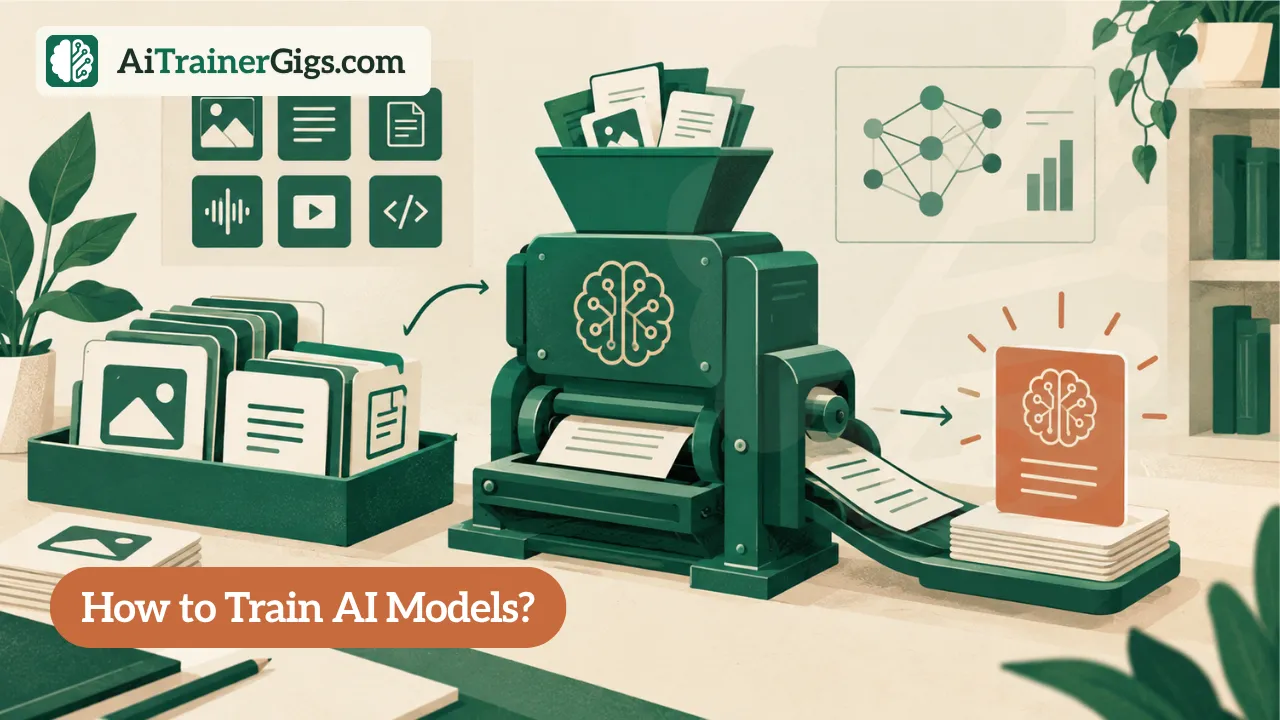
Want to understand how to train an AI model without drowning in jargon? You're in the right place. This guide explains the whole process in plain English — what training actually means, the steps from raw data to a working model, how long it takes and what it costs, and the part most articles skip: where real people get paid to do this work. No maths degree needed.
Training an AI model is teaching software to spot patterns from examples so it can make good predictions on things it has never seen. Think of it like teaching a child with flashcards, just at a huge scale. You'll see how the pieces fit together, and where you could fit in too.
Let me start with the big idea, then the steps.
What "training an AI model" really means
An AI model is a program that learns from data instead of following rules you write by hand.
Here's the loop in simple terms. The model looks at an example and makes a guess. You compare its guess to the right answer. The gap between them is the "error" (engineers call it loss). The model nudges its internal settings — its "weights" — to shrink that error. Then it repeats, millions of times, until the guesses get good.
That's it. No magic. Just guess, check, adjust, repeat.
The three ways to train an AI model
Before the steps, know that there are three broad approaches. Which one you'd use depends on your goal and budget.
Training from scratch
You build a model from nothing using a massive dataset — often millions of examples — and heavy computing power. Big labs do this. It's expensive and slow, and almost nobody starts here.
Fine-tuning a pre-trained model
You take a model someone already trained and adjust it for your task with a much smaller dataset. It's faster, cheaper, and the practical choice for most people and teams. If you ever "train" an AI in real life, it's probably this.
Reinforcement learning from human feedback (RLHF)
The model produces answers, humans rate them, and the model learns from those ratings. This is how chatbots are shaped to be helpful and safe. And this is the approach that creates paid work for ordinary people — more on that below.
The steps to train an AI model
Whichever approach you use, the workflow rhymes. Here are the core steps to train an AI model, start to finish.
1. Define what you want it to do
Pick one clear, measurable job. "Sort emails into spam or not spam." "Predict which customers will cancel." Vague goals are why most projects fail before they start. Ask yourself: what does a correct answer look like?
2. Collect and prepare the data
This is where the real work lives. Gather your examples, clean them (remove duplicates, fix errors), and label them so the model knows the right answers. Then split the data into three parts — usually about 80% to train on, 10% to tune with, and 10% to test on.
One firm rule: never let the model see the test set during training. That's how you find out if it truly learned or just memorised.
3. Choose a model to start from
Match the model to the task. Text jobs use language models; image jobs use vision models. Beginners don't need to build anything — you pick a proven pre-trained model and adapt it. Low-code tools exist that hide most of the complexity.
4. Run the training
Feed the data in and let the model learn. You set a few dials — how fast it learns, how much data per batch, how many passes over the data. Small jobs run on a free tool like Google Colab; big ones need powerful GPUs.
5. Test and evaluate it
Now show it the test set it has never seen and measure how it does. Common scores include accuracy and precision. If it does great on training data but poorly on the test set, it "overfit" — it memorised instead of learning, and you adjust.
6. Deploy, monitor, and improve
Put the model to work, then watch it. Real-world data drifts over time, so performance slips and you retrain with fresh examples. Training is never truly "done" — it's a loop.

How long does it take, and what does it cost?
It ranges wildly, so here's a rough map.
Fine-tuning a small model: minutes to a few hours, often free or a few dollars of cloud time.
A small model from scratch: days, low to mid hundreds of dollars.
Large-scale systems: weeks or months, and costs that run into millions.
Data needs scale the same way — fine-tuning may take hundreds of examples, training from scratch needs thousands to millions.
Do you even need to train a model?
Honest question worth asking. Training is often not the fastest fix. Before it, people try:
Prompt engineering — just writing better instructions for an existing model.
Retrieval (RAG) — giving the model your documents to read at answer time.
Few-shot examples — showing a couple of examples inside the prompt.
If one of those solves your problem, you skip training entirely. Reach for training when you need the model to behave differently at its core.
Where humans come in — the part that pays
Here's the piece most technical guides gloss over. AI can't train itself. Every capable model depends on people to create, check, and rate its data — and companies pay well for that judgment.
Data labeling and annotation
Someone has to tag what's in an image, mark the right answer in a document, or transcribe audio. This is data annotation job, and it's the entry point for most people. No coding needed.
Rating answers and RLHF
Remember RLHF? That's the model generating answers and humans scoring them. Professionals in coding, medicine, law, finance, and languages get paid to review outputs and catch mistakes — often $30 to $100+ an hour for expert work.
So when people say they "get paid to train AI," this is what they mean. You don't build the model. You're the human feedback that makes it smart.
Can you train an AI model yourself as a beginner?
Yes — a small one. You don't need a supercomputer to learn the basics.
Start tiny. Use a free notebook like Google Colab, grab a clean, small dataset, and fine-tune a simple model or run a beginner tutorial. Skip giant deep-learning projects at first. The goal is to feel the loop — data in, train, test — not to build the next ChatGPT on a laptop.
If your real interest is earning rather than engineering, you can skip the coding path entirely and get paid to help train models as a reviewer or annotator instead.
Get paid to help train AI models (no coding needed)
You don't have to write a line of code to be part of this. Companies hire people worldwide to label data, rate answers, and review AI output — the human side of training.
If you want to get paid to train AI then you have to work for companies who providing AI training services to big fish AI platforms like ChatGPT. You can browse list of platforms who provide these type of jobs on our website. Choose the best platform and see their availabe jobs and apply.
Conclusion
That's how to train an AI model, minus the intimidating parts: define the task, prepare good data, pick a model, train, test, and keep improving. The single biggest lesson is that a model is only as good as the examples people give it.
And that's the opening for you. Whether you want to build small models yourself or simply get paid to be the human feedback behind them, the door is wide open. Pick one small step and take it this week.