
Data Annotator - Video Content
Data Annotation·Remote·2mo ago
Visual DiscriminationProcess Adherence+2
20 spots left
$10–12 / hr
Job category
Data annotation jobs are one of the most accessible ways to get paid working on AI — you label the images, text, audio, and video that teach machine-learning models what things are. We pull real, remote data annotation jobs from vetted platforms into one place, with plain notes on what each pays and how it hires.
Showing 1–24 of 45
The work
What you'd actually be doing, day to day.
Every AI model learns from examples that a human labelled first. A self-driving system needs someone to draw boxes around cars and pedestrians. A chatbot needs people to mark which answers help and which are wrong. That labelling is data annotation — the quiet human work behind almost every AI product you use.
The tasks are more varied than most people expect. Some days you tag objects in photos. Other days you transcribe speech, sort text by sentiment, check a translation, or review a model's output against a rulebook. The work rewards patience and precision far more than any fancy degree.
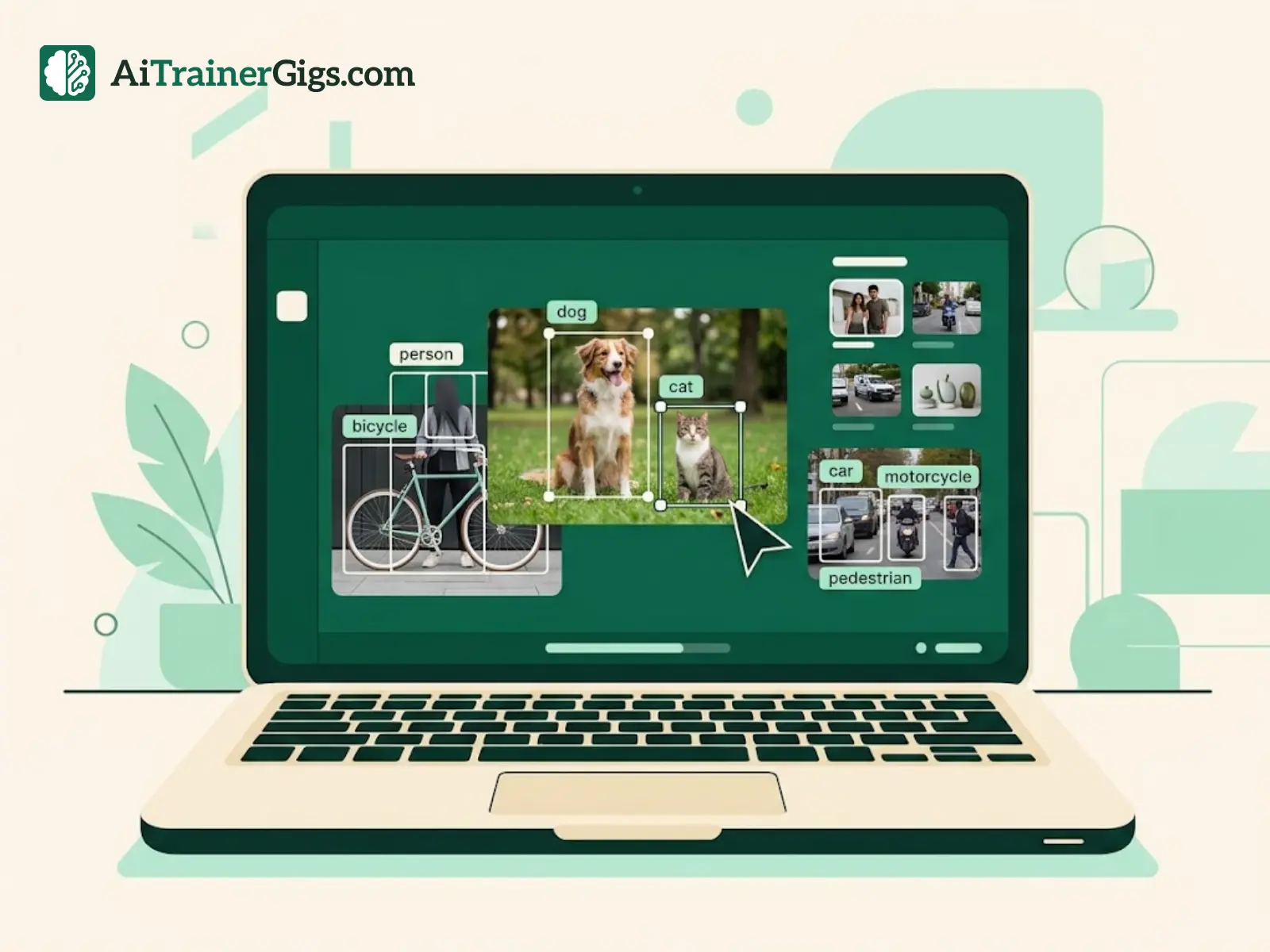
Draw bounding boxes, segment objects, and tag frames so computer-vision models can 'see'.
Mark sentiment, intent, named entities, and categories that teach language models meaning.
Turn speech into accurate text and label speakers, accents, and background noise.
Rank AI answers and flag errors so models improve from real human feedback.
Money
Honest ranges, and the context that moves them.
Pay is the first thing everyone asks about, so here's the honest picture. Rates swing widely because “annotation” covers everything from a two-minute tagging task to expert legal review. Simple, high-volume work often lands around $3 to $8 an hour, especially in lower-cost regions. Skilled work pays a lot more.
Bring a second language, a coding skill, or a professional background — medicine, law, finance, science — and specialist tasks regularly reach $15 to $40 an hour, sometimes higher on platforms that compete for expert raters. Some jobs pay by the hour; many pay per task, so your real rate depends on how fast and how accurately you work. We show a plain pay figure on every listing above so you can judge a role before you sink an evening into its qualification test.
Entry tagging
$3–$8 / hr
Skilled / language
$10–$25 / hr
Expert review
$25–$40+ / hr
Where to look
The platforms that actually hire — and how we vet them.
Almost all of this work is remote. The trouble is that AI data annotation jobs rarely show up on the big job boards — they live on a scattered set of specialist platforms that don't market themselves well. That's the exact gap we built this site to close.
The platforms worth knowing include Mercor, Micro1, Outlier, DataAnnotation.tech, Toloka, and Scale. Each hires remote AI annotation jobs on slightly different terms — some lean toward expert coders, others take absolute beginners. Rather than sign up to all of them blind, read our honest platform reviews first, where we lay out pay, payout reliability, and how each one onboards. Want work-from-anywhere roles specifically? Our remote AI jobs feed collects every remote listing in one view.
Getting started
You don't need a CV or a tech background to begin.
Good news for beginners: most platforms judge you on a short qualification test, not a CV. You read the guidelines, complete a sample task, and if your accuracy is good enough you start receiving paid work. That's how a lot of remote AI annotation jobs open up to people with zero background in tech.
Start narrow. Pick one platform, learn its rulebook properly, and keep your quality scores high — that's what unlocks the better-paid queues over time. Once you've found your feet, our entry-level AI jobs page lists more beginner-friendly roles, plenty of them ai annotator jobs remote enough to fit around another job or studies.
Stay safe
One rule filters out most scams in this space.
This niche attracts scams because it's beginner-heavy and remote. One rule filters out most of them: real work pays you, it never asks you to pay first. Walk away from any “job” that wants money for a starter kit, a course, a certification, or equipment before you've earned a cent.
Watch for the other red flags too — guaranteed hourly earnings that sound too high, pressure to move onto WhatsApp or Telegram straight away, or a request for banking details before any task exists. Every platform we list is checked against real payout reports and worker reviews before it goes on the board, and pulled the moment it stops paying — that's the promise, and it's how the referral links behind this site stay honest.
Yes — data annotation is real, paid work that every major AI company relies on to train and test its models. The catch is that the space is full of scams too, so stick to platforms that pay you and never ones that ask you to pay a fee, buy a course, or hand over ID before any work exists.
Pay varies a lot. Simple tagging tasks can sit around $3–$8 an hour in some markets, while specialist work — coding, medical, legal, or expert review — often pays $15–$40 an hour or more. Your rate depends on the platform, the task difficulty, and your skills.
Most annotation work is fully remote, and a good share of it is genuinely beginner-friendly. You usually pass a short qualification test instead of showing a résumé, so no experience is fine to start — you build up to higher-paying tasks over time.
For entry-level tasks you mainly need attention to detail, careful reading, and the discipline to follow guidelines exactly. Higher-paying AI annotation jobs reward domain knowledge — a language, a coding skill, or a professional field like law or medicine.
Pick one or two vetted platforms, create a profile, and complete their qualification test. Start with the tasks you're offered, keep your quality scores high, and you'll unlock more (and better-paid) work. Browse the open roles above to apply today.
Platforms like Mercor, Micro1, Outlier, DataAnnotation.tech, Toloka, and Scale all hire remote annotators, though pay and reliability differ. See our platform reviews for an honest breakdown before you sign up.
Browse every verified AI training gig on the live board, or start with the beginner guide if this is all new.


