Medical Revenue Manager
Business·Remote·United States·2mo ago
3 spots left
$88 / hr
Browse 1,459+ verified remote AI training jobs from Mercor, Micro1, Turing and more — one feed, no experience needed for many roles, free to apply. Updated daily.
Which answer is better?
Showing 157 newest AI training jobs · updated daily. Filter by role, platform, country or experience level.
Here's what I'll walk you through: what these roles really are, what they pay, who can apply, and how to land your first one. Short version? People all over the world get paid by the hour to help teach AI, often from their kitchen table. Want to see if it fits you? Keep reading.
AI training jobs are some of the easiest remote work you can start this year, and you don't need to be a coder to do them. On this page you'll find live openings from trusted platforms like Mercor, Micro1, AfterQuery, Turing and SME.careers, all in one feed. I built this site so you can skip checking five different sites and just apply where the work actually is.
These roles are simple to describe. You help make artificial intelligence smarter, and you don't build the AI. You teach it, by labeling data, writing example answers, rating replies, and flagging mistakes. Think of yourself as a tutor for a very fast student that still gets a lot wrong.
Big AI labs need real humans for this. A model can read the whole internet and still not know what a good answer looks like. That's where you come in. Companies hire for these roles through platforms, and I pull those openings into one place.
Most of this work is flexible and paid by the hour. Some people call it AI data training. Others call you an AI trainer, or an artificial intelligence trainer. Same idea: your judgment shapes how the AI behaves. Get it right often enough and the models people use every day get a little more accurate because of you.
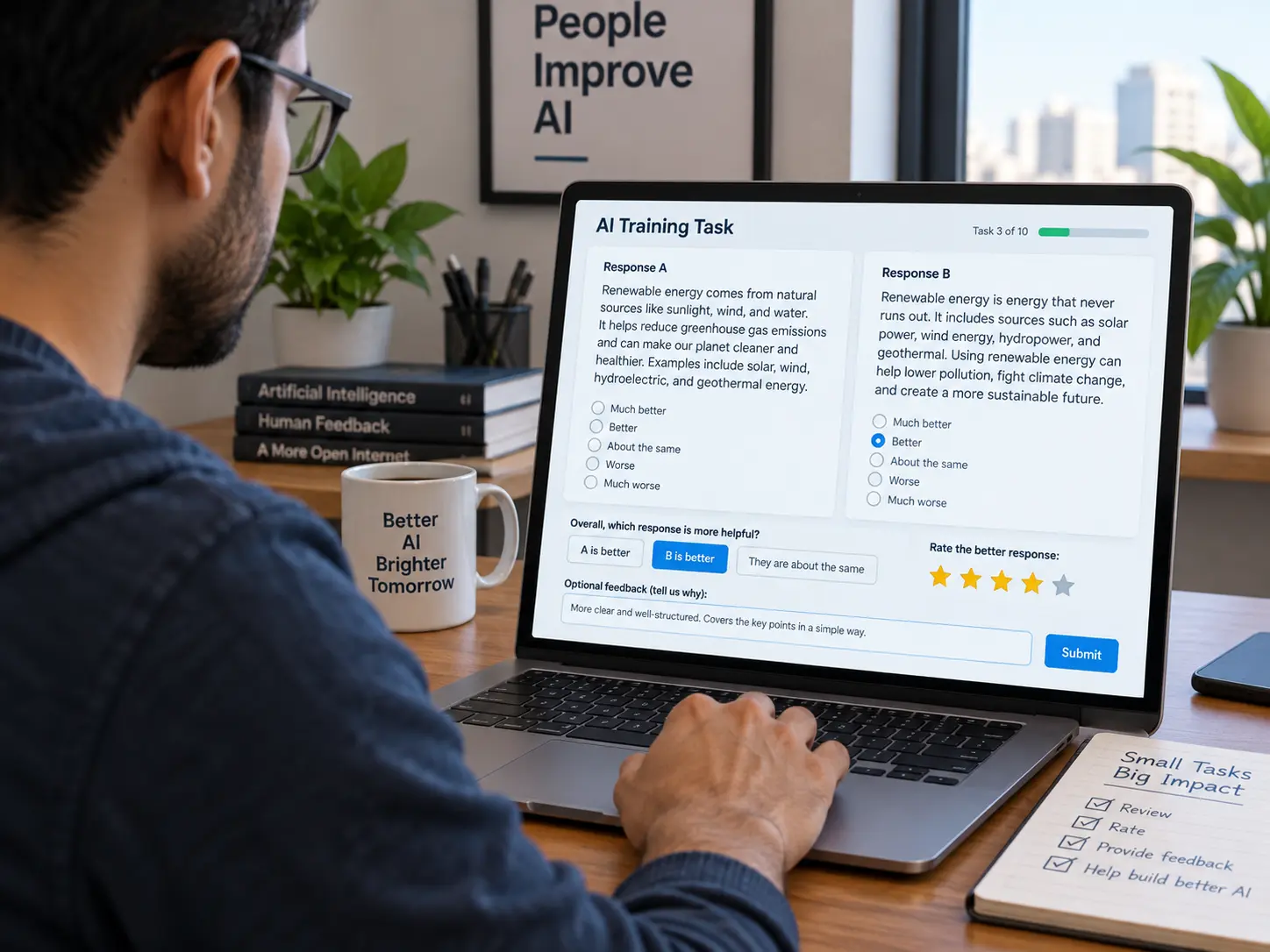
What does a normal shift look like? It depends on the project, but the common tasks are simple:
You work at your own pace, task by task. No meetings. No boss over your shoulder. Just you, clear instructions, and a screen. Some AI trainers do an hour before bed. Others treat it like a full-time job.
People mix these terms up a lot, so let me clear it up. Data annotation and data labeling mean roughly the same thing: tagging raw data, like a photo, a sentence, or a clip, so AI can understand it. AI training is the bigger umbrella. It includes annotation plus writing, rating, and evaluation work.
So every annotation gig is an AI training job, but not every AI training job is annotation. A listing that says data labeling means tagging work. One that says trainer or evaluator means more writing and judgment.
In practice, the label on a listing tells you what to expect. Annotation and labeling work is steady and repetitive, and it's the easiest way in. Trainer and evaluator roles ask for a bit more judgment and clear writing, and they tend to pay more for it.
Don't overthink the titles. Start with whatever's open, learn how the tasks flow, and move toward the work that suits you.
Why are there so many of these roles right now? Every new AI model needs mountains of human feedback before it's any good. As more companies race to launch chatbots and tools, the need for people who help train AI keeps climbing.
The math is simple. Better data makes better models. Better models need more trainers. That loop is not slowing down. LinkedIn alone lists hundreds of thousands of AI-related openings, and specialist platforms post fresh projects every day.
Which fields are hottest? The top ones are coding, math, medicine, law, and finance, because models struggle most with expert-level answers. Languages matter too, especially ones with little data online. So your background probably fits somewhere.
However you describe it — training AI, teaching models, or reviewing their answers — the demand is the same, and you don't need a big CV to work for AI companies today. Now is a good time to start.
The work splits into a few clear buckets. Some need no experience at all. Others reward a degree or a trade. Here’s the map.
This is the classic entry point. You tag data, draw boxes around cars in photos, mark whether a review is positive, or transcribe short audio. It's repetitive but easy to learn, and most projects need zero background. Pay sits at the lower end, yet it's a solid start.
Browse all data annotation jobsKnow your way around biology, physics, chemistry, or maths? AI labs pay well for researchers who can answer hard questions, check a model's reasoning, and catch where its science is wrong. Your degree or research background is exactly what these projects are short of.
Browse all science AI jobsThe newest, fastest-growing corner: building and testing AI agents that plan and act on their own. You design the tasks they practise on, wire them to real tools, and hunt for where they break. Some roles are engineering-heavy, others just need sharp testing.
Browse all AI automation jobsChatbots learn from example chats. You write dialogue, fix clumsy replies, and help the bot sound human. Enjoy writing? You'll like this one.
Browse all chatbot training jobsNew to all this? Plenty of projects take complete beginners. If you can read carefully, follow instructions, and write clear English, you can start today, learn on the job, and move up to the higher-paying work as your track record grows.
Browse all entry-level jobsGot a degree or a trade? This is where the money is. Platforms pay top rates for experts who can check code, review medical answers, or judge legal reasoning. A nurse, a lawyer, a software engineer — your day-job knowledge becomes a side income. Browse every field in one place.
Browse AI jobs by industryLet's talk money, since that's probably why you're here. Pay depends on the task and your skills. General work pays modestly. Expert work pays a lot. Below are typical 2026 US hourly ranges across the industry.
| Role / tier | Typical hourly pay (USD) | Experience needed |
|---|---|---|
| General annotation & labeling | $12 – $20 | None |
| Response evaluation / rating | $17 – $25 | None |
| Chatbot / conversation training | $15 – $30 | Entry |
| Coding evaluation & AI QA | $35 – $120 | Technical |
| Domain experts (PhD, medical, legal) | $50 – $200+ | Advanced |
The average US AI trainer wage sat near $31 an hour in 2026, with beginners around $20 and top earners past $45. Your country and platform move these numbers, so treat them as a guide, not a promise.
Want a raise? A few things move the needle:
Start simple, prove you're reliable, then apply for the paid AI training projects that sit higher up the pay scale. The trainers who earn the most treat it like a craft: they read the guidelines closely and keep their accuracy scores high.
Most platforms pay per task or per hour, and send money every week or two. You'll usually receive it through PayPal, bank transfer, or a service like Wise. Payments are in US dollars on most platforms, which helps a lot if you live somewhere with a weaker currency.
Always check the payout method before you start a project. Some platforms hold a small minimum before your first payout, so read the terms. There's no invoicing and no chasing clients — the platform tracks your approved work and pays out on its own schedule, steadily, once you're active.
Short answer: no. Most of these roles are open to beginners. Can you read carefully, follow instructions, and write clear English? Then you can start with annotation, rating, or chatbot work today.
Experience helps you earn more, not get in the door. Plenty of trainers began with zero background and learned on the job. So don't count yourself out because your CV looks thin.
The bar is low on purpose. What earns you better projects isn't a degree — it's accuracy, honesty, and turning work in on time. Do that for a few weeks and the higher-paying tasks start to open up on their own.
You'll need a few basic things:
Not sure your background counts? A teacher's eye for clear writing, a nurse's care with detail, a gamer's patience with repetitive tasks, all of it transfers. You bring more to the table than you think.
That's really it. No degree for entry roles. Some AI job training happens right inside the platform, with short guides before each task. Follow a recipe? Then you can follow these instructions.
Which platforms actually hire? I track openings from the biggest names and pull them into one feed. Here are the main ones you'll see:

The strongest pipeline for credentialed experts. Contracts are clear, and workers report payouts landing on schedule.
Read the full review →
Highest ceiling on this list for law and medicine. Sourcing is spiky — set alerts rather than checking manually.
Read the full review →
Strong fit for advanced-degree experts. No prior AI-training experience needed, weekly payouts via Deel, and a clear application flow.
Read the full review →
Huge volume and variety of gigs. Pay isn't always listed up front, but the breadth of roles is unmatched on this list.
Read the full review →
Competitive rates and genuinely expert-level work. Roles are project-based and specialised, so openings move fast.
Read the full review →Instead of making an account on each site, you browse them all here and apply directly on the source platform. No middleman, no fee. Want the best AI training jobs across every platform in one view? That's the whole point of this feed. You'll also spot AI trainer jobs from labs you may never have heard of.

Nearly all of this work is remote. You can do it from home, a café, or a shared workspace, wherever you have a laptop and wifi. That's the real draw: no commute, no fixed hours, and often no fixed country.
Demand is strong in the USA and India, and growing fast in Bangladesh, Pakistan, and Indonesia. Many projects are open worldwide, though some limit tasks to certain countries or languages. Each listing shows its own location rules, so check before you apply.
Whether you're after fully remote AI training jobs, work-from-home roles, or a flexible side income as a remote AI trainer, it all points to the same location-independent work in the feed above.
Yes, this work is completely legit. Real companies pay real people to train their models every day. But scams do circle remote work, so keep your guard up.
How do I keep the feed clean? I only list roles from platforms with a real track record, and each job links straight back to source. No fake reposts, no shady middlemen.
Apply direct, never pay up front, and you'll stay on the safe side. Trust your gut, too, if an offer feels off, it usually is.
Ready to start? Here's the simple path:
Browse the live listings on this page and filter by role or country.
Pick a platform that matches your skills.
Create a free profile and finish the short skills test.
Apply directly and begin your first AI trainer job once you're approved.
Most people go from signup to first task within a few days. Begin with easy annotation work, build a track record, then move up to the higher-paying projects.
Read every instruction twice and go slow. Accuracy matters more than speed at the start, since your early scores decide which projects open up next. Rush it and you'll get fewer invites.
Why use this site instead of hunting on your own? Four reasons:
I gather listings from Mercor, Micro1, AfterQuery, Turing, and SME.careers, so you check one feed, not five.
I screen listings so you skip the scams.
Roles open worldwide, including no-experience work.
Always free, and you apply on the source platform.
You waste real time chasing links across a dozen tabs. I did that sorting for you, so you spend your hours applying, not searching.
So, is this for you? Want flexible, remote work that pays by the hour and doesn't need a fancy CV? Then this work is worth a real look. I've tried to put everything in one place so you can start today, not next month.
Pick a listing, make your profile, and give it a shot. Worst case, you learn something new. Best case, a steady income from your laptop. I'm rooting for you. Go find your first project.
Yes. These roles are legitimate, and major AI labs pay people worldwide to label data and review answers. Apply only through trusted platforms, and never pay to join.
No. Most entry-level roles need only careful reading and clear English. Experience helps you earn more, but complete beginners can start right away.
General tasks pay about $12 to $25 an hour, while expert roles reach $50 to $200 or more. The US average was around $31 an hour in 2026.
An AI trainer teaches AI by labeling data, writing example answers, rating responses, and flagging mistakes. The work is remote and mostly non-technical.
Yes. Almost all of this work is remote, and many projects are open worldwide, though some are limited by country or language.
Browse the listings on this page, pick a platform, create a free profile, pass a short skills test, and apply directly.
Clear writing, sharp attention to detail, and a second language are always in demand. Expertise in coding, medicine, law, and finance pays the most.
No. Most roles need no coding at all. Python only helps for technical projects like code evaluation, which happen to pay more.
Never pay to start, and skip any offer that wants your bank login or promises big money for nothing. Real platforms are free and pay you, not the other way round.
The 15 best-paying new listings, every Monday. No fluff.